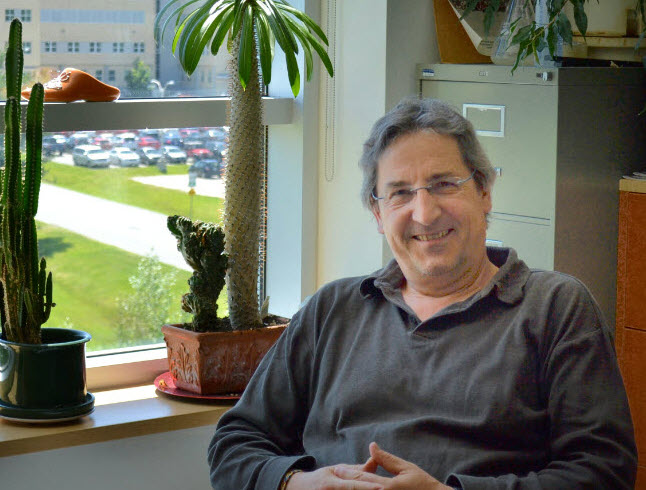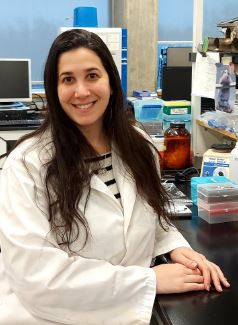


Chercheur Principal / Principal Investigator (i.e. THE Boss)
"I'm interested in everything, particularly those things others find uninteresting..."
http://wellingerlab.org/mundys-bio
Contact details:
Department of Microbiology and Infectious diseases
Applied Cancer Research Pavilion, room 3025
Université de Sherbrooke
3201, rue Jean-Mignault
Sherbrooke, Québec
J1E
4K8Canada
e-mail: raymund.wellinger@usherbrooke.ca
phone: ++ 1 819 821 8000 ext 75214
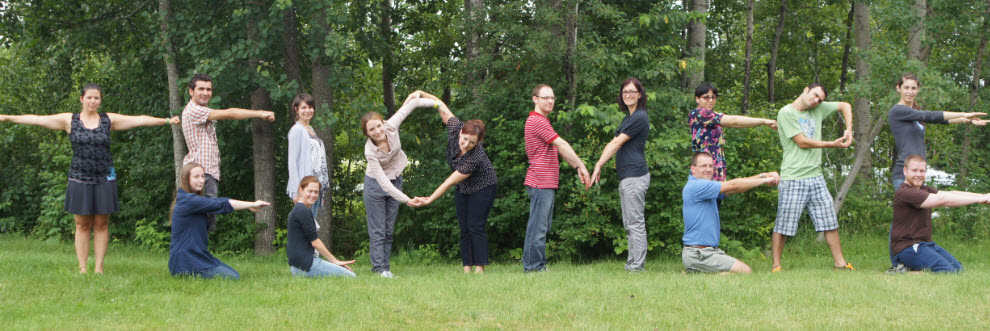
The "TELOMERE" people...
My project involves analyzing telomere-related phenotypic variations caused by new alleles of certain essential genes that were chosen based on functions that may be linked to telomere homeostasis. Further characterization of the genes and how they interact with known genes of telomere maintenance is done by a variety of methods.
Recent studies of telomerase components with respect to the cell cycle and its maturation process suggests dynamic changes of protein composition. The regulation of these changes and possible implications of post-translational modifications (PTMs) of Tlc1 associated proteins are completely unknown mechanisms that I wish to investigate in detail. In order to assess the protein composition of the telomerase RNP, I will develop large scale culturing of yeasts that are arrested in various phases of the cell cycle or in which the Tlc1 maturation is blocked and I will perform MS analyses of active telomerase RNPs obtained via a tagged Tlc1 RNA and isolated on IgG beads. The results from these experiments have the potential to uncover new and cell cycle regulated telomerase components.
Recently, our lab has discovered new components of the yeast telomerase holoenzyme, the Pop proteins (Pop1, Pop6 and Pop7). Those proteins were first known to be an essential part of the RNase P and RNase MRP holoenzymes. Currently, the purpose/roles of the Pop proteins and their mechanisms of interaction with Tlc1 and possibly other telomerase components remain relatively uncharacterized. To understand how telomerase is working, it is essential to understand the telomerase-related activity of the Pop proteins. In order to do that, I’m working with different molecular and biochemical techniques to study how Pop1 interacts with yeast telomerase.
To our knowledge, no subtelomeric element has yet been identified in any organism as a regulator of telomere length homeostasis, despite the fact that differential telomere length homeostasis according to specific chromosomal ends has been suggested before. My current project is centered on studying atypical chromosomal end-behavior and identifying subtelomeric chromatin determinants involved in the process.
Trying to understand the
function and life cycle of just one protein or RNA in a crowded
cell can seem like an insurmountable task. Luckily, we can utilize
and combine current molecular techniques, such as fluorescence
microscopy and immunoprecipitation, to gain initial insight into
interactional partners at various cellular stages. This can then be
built upon and further investigated. Currently, we are using
initial characterization methods to follow the dynamics of the
essential yeast telomerase component 1 (TLC1)
RNA.
Copyright | Wellinger Lab 2019